Scale-up of Enzyme Production for Cyclodextrin Biomanufacturing
Cyclodextrins are naturally occurring cyclic oligosaccharides, a type of sugar molecule with a doughnut shape that can capture other molecules. This unique property gives them solubilising and stabilising properties that mean they have a wide range of applications in pharmaceuticals, personal care, food, and household products.
NCIMB Ltd, an Aberdeen-based microbiology company, is developing novel enzyme technology to produce a new cyclodextrin product using bacterial fermentation.
Challenge
As part of their UKRI Launchpad project for Biomanufacturing in Scotland, NCIMB sought to transition their bench-scale process for producing the enzyme from static flask cultures to a controlled fermentation system suitable for larger-scale enzyme production.
To enable this transition, NCIMB subcontracted the fermentation scale-up and enzyme recovery work to the Industrial Biotechnology Innovation Centre (IBioIC), leveraging the FlexBIO facility and technical expertise in bioprocess development and downstream processing.
Solution
Under the UKRI Launchpad programme, IBioIC supported NCIMB by scaling up the mid-stage fermentation and downstream processing of the enzyme.
Initial small-scale tests were carried out at FlexBIO to reproduce NCIMB’s static flask protocol in controlled shake flask fermentations to confirm suitable growth kinetics and enzyme expression profiles.
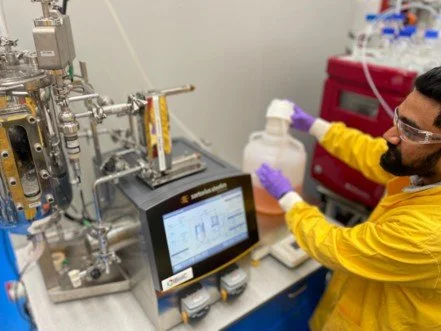
Once successful replication of the culture conditions had been achieved, FlexBIO conducted a scale-up fermentation in 7 L bioreactors under controlled conditions over a 24–48-hour run. The fermentation achieved the target biomass and enzyme production levels required for downstream processing.
After fermentation, the harvested material underwent a series of downstream bioprocessing steps to remove impurities, concentrate the enzyme, and transfer it into an optimal formulation buffer to maintain stability and activity.
The final preparation retained the active enzyme, suitable for NCIMB’s ongoing research into enzymatic cyclodextrin production.
Outcome
Through this collaboration, IBioIC successfully:
Scaled up the fermentation from flask to bioreactor scale (5 L working volume).
Developed and executed a series of downstream bioprocessing steps to refine, stabilise, and prepare the enzyme material for further use.
Delivered active enzyme material back to NCIMB for use in ongoing bioconversion and cyclodextrin synthesis studies.
The work demonstrated IBioIC’s ability to provide targeted process development and biomanufacturing scale-up services to support UK industrial biotechnology companies during key stages of innovation.
The active enzyme produced through this collaboration is now being utilised by NCIMB to produce and characterise its novel cyclodextrin product — a technology and product with broad industrial application.
Dr Brandon Childers from NCIMB presented the outcomes of this work at the IBioIC Annual Conference (March 2025), highlighting the advances made under the UKRI Launchpad for Biomanufacturing in Scotland and showcasing how collaborative projects like this strengthen Scotland’s industrial biotechnology landscape.