
HND in Industrial Biotechnology: a hands-on route into Scotland's biotech sector
A career in industrial biotechnology doesn't have to start at university. Scotland's HND is a practical, industry-connected qualification at SCQF level 8 that gets you into the sector faster - with direct routes to employment and a clear pathway to university if you want it.

Why choose an HND?
Hands-on, practical learning
You'll spend significant time in the lab developing real technical skills — the kind that employers are actively looking for from day one.
Direct route to employment
The HND is designed to get you job-ready. Graduates move into laboratory, production, quality and process roles across Scotland's biotech sector.

Progress to university
Defined articulation routes mean HND graduates can enter degree courses at second or third year — at universities across Scotland. You can even study part-time.
Strong industry connections
IBioIC works with colleges to bring students into direct contact with industry through the Engage and Inspire programme and company site visits.
What you'll study
The HND in Industrial Biotechnology gives you a broad and rigorous grounding across the three core disciplines of the sector: chemistry, biology and process engineering. You'll develop both the theoretical knowledge and the practical, laboratory-based skills that biotechnology companies need, making you genuinely employment-ready from the moment you graduate.
IBioIC's support for HND students. We work closely with colleges to enrich the student experience, including our Engage and Inspire programme, which connects you with practitioners and specialists from across the sector (including patent attorneys, recruitment specialists and regulatory experts), site visits to local companies and SMEs, and career pathway showcases featuring former HND students.
Where could an HND take you?
An HND in Industrial Biotechnology prepares you for a wide range of roles in the sector. Here are some of the most common first destinations for our graduates. Many of these roles come with the opportunity to progress into more senior technical or supervisory positions over time:
Laboratory Technician
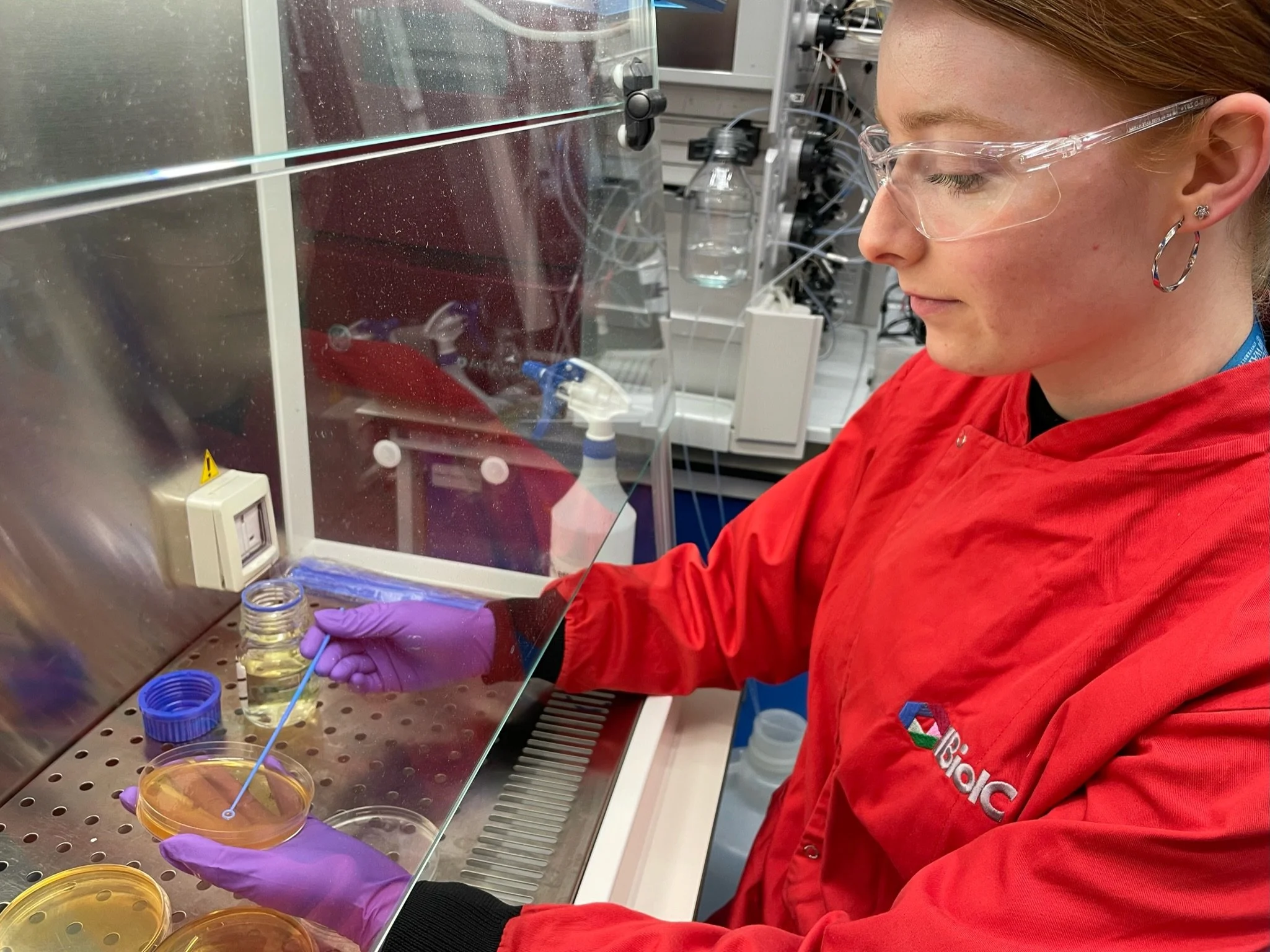
Laboratory technicians support scientists and researchers by carrying out experiments, tests, and routine lab work. This role is often found in research and development teams, where accuracy and good record keeping are essential.
Typical day-to-day tasks:
Preparing samples and solutions for testing
Running experiments and tests following set procedures
Recording results clearly and accurately
Cleaning, calibrating, and maintaining lab equipment
Ordering and stocking lab supplies
Following health and safety guidelines at all times
Good to know: This role suits someone who is organised and enjoys hands-on, practical work. Entry is often possible with science-based qualifications from school or college, and many employers offer laboratory apprenticeships.
Process Operator
Process operators run and monitor the equipment used to manufacture biotechnology products, such as fermentation tanks or purification systems. This role sits on the production floor and keeps manufacturing running smoothly.
Typical day-to-day tasks:
Starting up, monitoring, and adjusting production equipment
Checking gauges, readings, and process parameters
Following batch instructions and standard procedures
Spotting and reporting faults or unusual readings
Cleaning and preparing equipment between production runs
Completing production paperwork and logs
Good to know: A practical, methodical approach works well here, and some mechanical aptitude is helpful. Shift work is common in manufacturing environments. This is a popular route for apprentices and college leavers.

Quality Technician
Quality technicians check that products and processes meet the required standards before products can be released. This role helps make sure everything produced is safe, consistent, and compliant with regulations.
Typical day-to-day tasks:
Taking samples and carrying out quality tests
Checking production documentation for errors or gaps
Recording and reporting any deviations from standard procedures
Supporting internal checks and audits
Working closely with production and laboratory teams
Keeping accurate quality records
Good to know: Strong attention to detail is important, along with a willingness to follow strict procedures. Many quality technicians start with a science or engineering qualification and build up knowledge of quality systems on the job.

Manufacturing Associate
Manufacturing associates support the production of biotechnology products from raw materials through to the finished product. The role can involve working across several stages of the manufacturing process rather than one fixed task.
Typical day-to-day tasks:
Preparing raw materials and equipment for production
Operating machinery as part of the production process
Following standard operating procedures closely
Packaging and labelling finished products
Maintaining clean and controlled working areas
Completing production records
Good to know: This role is well suited to people who enjoy structured, team-based work. Full training is usually provided, making it accessible to school and college leavers with no prior industry experience.

HND Case Studies - hear from current and former students



Entry requirements
Entry requirements vary by college - check directly with your chosen institution for the most up-to-date offers. Standard requirements are shown below.
Scottish (SCQF)
Standard entry
Two Highers at Grade C or above - usually Biology and Chemistry, plus National 5 Maths.
England and Wales
Standard entry
Two to three A-Levels including Biology or Chemistry, plus GCSEs at grades 9–4 in English, Maths and Science.
Alternative qualifications
Also accepted
NC (Level 6) or HNC in Applied Sciences, a relevant Foundation Apprenticeship, or BTEC Extended Diploma (Merit, Merit, Pass).
Mature learners and those with relevant experience are also welcome to apply - colleges consider applications on an individual basis.
Find out about alternative routes into Industrial Biotechnology
Frequently asked questions
-
Yes. Colleges have defined articulation routes into university degree programmes across Scotland. HND graduates can typically enter into second or third year of a relevant degree course — and there are part-time study options available too. Speak to your college or prospective university directly about the routes available to you.
-
An HND in Industrial Biotechnology gives you practical, industry-relevant skills that employers are actively looking for. Roles our graduates go on to include laboratory technician, site technician, research associate, process operator and roles in quality and regulatory affairs. The qualification also opens doors to further study if you want to develop your career further.
-
No - the HND is designed to build your laboratory skills from scratch. You will need to meet the standard academic entry requirements (typically two Highers or equivalent), but previous lab experience is not a requirement. Check with your chosen college for their specific entry criteria.
-
Absolutely. A qualification in industrial biotechnology is suitable for learners of all ages. We have had many mature students graduate and go on to successful careers or university study. If you have relevant experience that might support your application, colleges will consider this alongside formal qualifications.
Ready to find out more?
Contact your local college directly to find out about entry requirements, application dates and available funding. IBioIC is always happy to answer questions about the HND and what it could lead to.