Aquatic to agronomic: making progress towards mechanistic functional understanding of algal biostimulants for agriculture
With a growing human population, there is increasing demand for high-quality, high-volume food production, which has led to increasing environmental pressure. Productivity has been stimulated through increased reliance upon agrochemicals, unsustainable inorganic fertilisers, and finite mineral reserves.
Algae and cyanobacteria are an incredibly biodiverse collection of organisms. They have been utilised by humans for centuries, including in agriculture. Currently, they are regarded as under-utilised sources of biomass which could benefit the agri-tech sector, owing to their potential to provide a myriad of plant growth promoting compounds including essential macro- and micro-nutrients and phytohormones that enhance stress tolerance in crops, alleviate desiccation stress, inhibit pathogenicity of pests in soils, and improve crop yield and quality. Despite a longevity of use, market availability, and renewed research interest in algal biostimulants, their efficacy and reproducibility vary and there is a lack of credible scientific evidence and availability of peer-reviewed empirical datasets. There are various unanswered questions and challenges to be addressed before algal biostimulants are more widely adopted into crop management and agriculture. Areas requiring greater understanding include: i) algal/cyanobacterial species selection; ii) cultivation practices, seasonality, and harvesting time on biomass composition; iii) biostimulants extraction methodologies; iv) application method, dosage, and frequency; v) effect on plants, soils, microbiomes, and productivity; vi) mode of action in plants and soils; and vii) circularity, economics, and environmental impact. Outcomes from this studentship will go a long way in understanding this ‘black box’ by undertaking a program of three main phases:
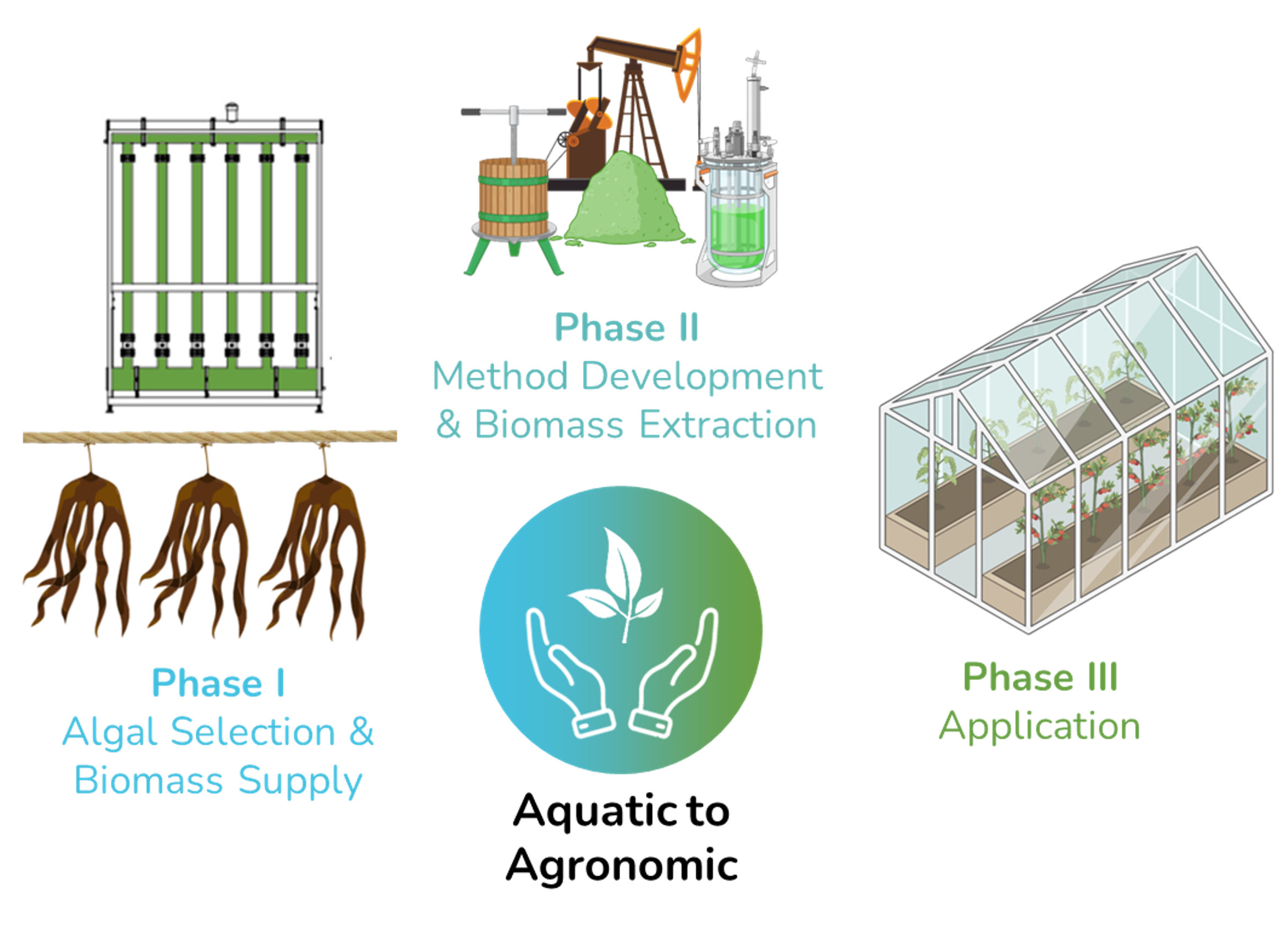
Phase I (learning and biomass supply) – The current state-of-the-art of seaweed /microalgal cultivation, biomass harvesting and extraction, and biostimulant applications will be learned (In partnership with the industrial partner - Kilchoan Melfort Trust). Quantities of commercially representative microalgae, cyanobacteria, and seaweed biomass will either be produced or procured.
Phase II (method and extraction development) – Biomass obtained from Phase I will be used to test best methods for extraction of high-value products (e.g., pigments) and as a raw feedstock for biostimulants. Whole biomass and resulting extracts will be characterised.
Phase III (application) – Whole cell biomass (Phase I) and biostimulants extracts (Phase II) will be tested on a range of crops in either hydroponic or pot-trial systems. Most promising extracts will return to Phase II for extraction refinement and optimisation.
Optional Phase IV (Techno-Economic/Life-Cycle Assessment) – Depending upon progress and results, the circularity of process and economic and environmental viability will be assessed, with recommendation for further areas of focus.
New knowledge generated during this PhD studentship will help to identify where greater research, development, and investment is required to make the most meaningful industrial biotechnology impact.
The proposed outcomes from this project are:
1) Skills and knowledge development of current best practice of seaweed cultivation, harvesting, biostimulant extraction and application (at industrial partner);
2) Acquire and characterise algal/cyanobacterial biomass suited to commercial-scale applications;
3) Learn and/or develop methods for extraction and quantification of high-value products from biomass (Outcome 2).
4) Learn and/or develop methods for extracting and characterisation biostimulants from biomass (Outcome 2), or biomass residues following high-value product extraction (Outcome 3).
5) Apply extracts from Outcomes 3&4 to a variety of suitable crops in pot or hydroponic trials.
6) Refine extraction methods and applications for most promising biomass/extracts from Outcome 5.
7) Develop of other technical skills (e.g., algal and crop cultivation, biochemical analysis, economic analysis).
8) Develop of academic skills (e.g., literature review, experimental design, report writing, project management/meeting updates, data analysis, thesis and paper writing, dissemination of results).
Director of Studies: Dr. Michael Ross (SAMS)
Supervisory Team: Dr Puja Kumari (SAMS-UHI), Dr Alla Silkina (Swansea University), Marnik van Cauter (Kilchoan Melfort Trust)
Funding:
This four-year PhD studentship is equally funded by The Industrial Biotechnology Innovation Centre (IBioIC) and the Scottish Association for Marine Science (SAMS) and follows UKRI funding guidance. Furthermore, there are in-kind funding contributions from Swansea University and the Kilchoan Melfort Trust.
The PhD studentship is funded to cover Home (UK) tuition fees, a maintenance stipend and a research training grant for consumables for the successful candidate, for four years. To qualify for full funding, the successful applicant must be eligible for Home (UK) fees status, i.e., must be either a UK National who meets residency requirements, or meet the requirements of the EU Settlement Scheme and have either settled status, pre-settled status (meeting residency requirements) or indefinite leave to remain or enter.
Applicants who qualify for international fee status are welcome to apply but please note that if successful, an international candidate would not be fully funded: they would be required to pay the difference between home fees and international fees. Annual tuition fees are subject to revision and typically increase between 1.5-3% per annum for continuing students.
HOW TO APPLY and KEY DATES
For full details and to download an application form, please visit the SAMS website: Aquatic to agronomic: making progress towards mechanistic functional understanding of algal biostimulants for agriculture — The Scottish Association for Marine Science
Closing Date for Applications: Friday 10th July 2026
Interview Date: Wednesday 5th August 2026
Interview Location: Via Microsoft Teams
Start Date: Thursday 1st October 2026
For queries about the project: Dr. Michael Ross (SAMS) - email Michael.Ross@sams.ac.uk
For queries about the application process: SAMS Graduate School team - email phd@sams.ac.uk