Scaling Up Nucleotide Purification Using Preparative Chromatography
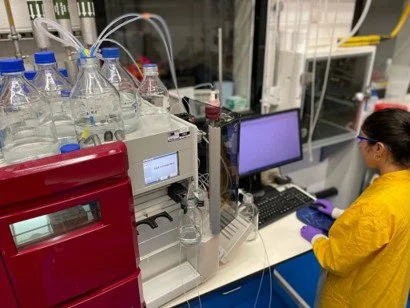
Scientist operating a fast protein liquid chromatography (FPLC) system to purify a sample in IBioIC’s FlexBIO lab.
Challenge
Researchers at the University of St Andrews, led by Professor Rafael G. da Silva, developed a novel biocatalytic process for the synthesis of 5-hydroxymethyl-2’-deoxyuridine 5’-monophosphate (5hmdUMP) — an important substrate used to investigate the catalytic mechanism of HsDNPH1, a promising target enzyme in anticancer drug development.
The team successfully demonstrated the small-scale enzymatic synthesis and purification of 5hmdUMP using an ÄKTA Start FPLC system, which enabled initial verification of the reaction. However, to support detailed kinetic and structural studies, the researchers required a larger quantity of the compound, necessitating a tenfold scale-up of the purification step.
To achieve this efficiently and within a controlled bioprocessing environment, the purification scale-up task was subcontracted to the Industrial Biotechnology Innovation Centre (IBioIC) through funding awarded via the IBioIC Innovation Fund.
Solution
Under the IBioIC Innovation Fund project, the University of St Andrews subcontracted the scale-up purification of 5hmdUMP to IBioIC’s FlexBIO facility.
Using the ÄKTA Avant chromatography system, capable of flow rates up to 150 mL/min, FlexBIO replicated and scaled up the St Andrews team’s anion-exchange purification method by tenfold. This allowed for the rapid and efficient purification of 5hmdUMP at preparative scale while maintaining product quality and consistency.
FlexBIO executed a 10× scale-up of the anion-exchange purification process at the FlexBIO facility, producing sufficient quantities of high-purity 5hmdUMP for downstream biochemical and crystallographic studies.
The subcontracted work provided the research team with the necessary scale-up capacity and infrastructure to produce larger quantities of biochemically verified material, enabling the next phase of their mechanistic research.
Outcome
The collaboration delivered a tenfold increase in purified 5hmdUMP yield, maintaining the same analytical purity as the small-scale runs, verified by HPLC, NMR, UV-VIS, and MS. The scaled-up purification was key to enabling comprehensive enzyme kinetics, isotope effect measurements, and crystallography, which were central to the findings published in ChemBioChem (Carberry et al., 2024).
The project, supported by the Scottish Funding Council via the IBioIC Innovation Fund, highlights how IBioIC’s facilities and expertise can provide targeted scale-up services to academic partners bridging the gap between laboratory research and preparative bioprocessing.
“We are very grateful to the IBioIC and FlexBIO for enabling us to upscale our biocatalytic production of 5-hydroxymethyl-2’-deoxyuridine 5’-monophosphate (5hmdUMP). 5hmdUMP is a cytotoxic nucleotide substrate for the human anticancer target enzyme DNPH1. The facilities and expertise within the IBioIC allowed us to increase 5hmdUMP purification 10-fold relative to in-house, providing us with enough substrate to elucidate the mechanism of human DNPH1 catalysis. Our protocol for biocatalytic 5hmdUMP production and work on the DNPH1 mechanism are now published in Chembiochem (2024:doi.org/10.1002/cbic.202400047)
and The Biochemical Journal (2025: doi.org/10.1042/BCJ20253400).”