Saving potatoes from bacterial disease
Introduction
Potatoes are the world’s fourth most important food. Blackleg disease and soft rots, caused by Pectobacterium and Dickeya spp lead to losses of £50 million annually in the UK and >$1 billion worldwide. The main source of infection is the inadvertent planting of infected seed potatoes. This introduces the bacteria into the crop and these then spread to healthy plants.
In the absence of any effective genetic resistance, and with chemical treatments relatively ineffective and environmentally undesirable, current control measures rely on field inspection of seed potatoes looking for evidence of disease. Failure to meet strict standards means downgrading or condemnation of a seed tuber crop, with the resulting waste and cost to growers. There is significant appetite from growers for an effective and environmentally friendly method of controlling the disease.
The Challenge – developing a treatment for seed potatoes
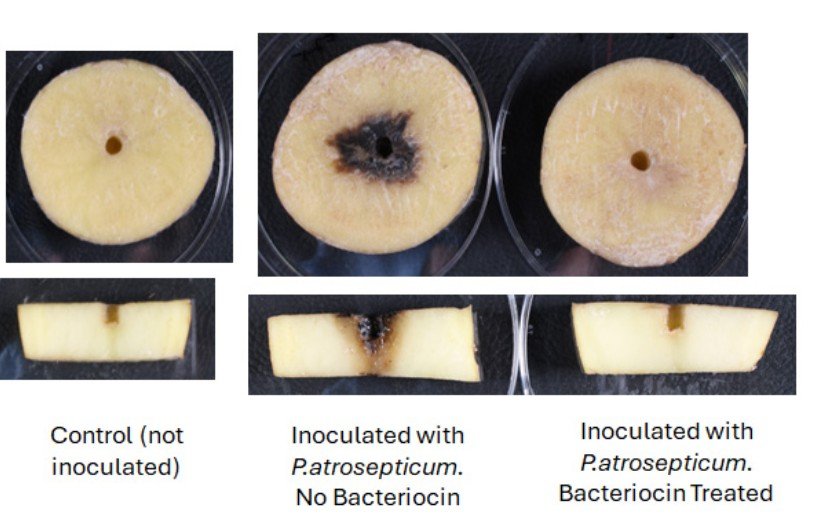
Research groups at the Universities of Glasgow and Strathclyde are developing treatments for seed potatoes that rely on the use of bacteriocins, non-conventional protein antibiotics that show strong narrow spectrum killing activity against related bacterial species. They have developed a discovery and testing pipeline for bacteriocins with potential for application in a potato treatment
The University of Glasgow proposed a spin-out, Casdu, to exploit this pipeline to develop, produce (or licence the production of) bacteriocin-based prophylactic treatment(s) which could be applied post-harvest to seed potatoes to inhibit the growth of the bacteria which cause blackleg disease and soft roots, and to prevent the spread of bacteria from infected tubers.
IBioIC support enables a solution to be developed
Funding from IBioIC’s Feasibility Fund enabled Casdu to work with the University of Glasgow to screen bacteriocins for activity, identify strong candidates for expression in plants, and test activity in plant species. Assays were conducted using bacteriocin combinations and mutations which lead to bacteriocin resistance were identified. Protocols were also developed in relation to bacteriocin assays.
Successful outcome supports ongoing collaboration and moves the project towards securing IP
The successful outputs from this project were critical in securing significant follow-on funding from BBSRC to progress towards commercialisation. This funding is now being used to support a collaboration between the Universities of Glasgow and Strathclyde, and The James Hutton Institute, in particular the extension of the work that has resulted in the potential formulation of a bacteriocin cocktail for use as a treatment and testing in field and glasshouse trials. Moves to secure IP by patent registration is currently in progress.
In subsequent work, directly progressing from that supported by IBioIC, 15 candidate bacteriocins (13 previously completely unknown) have been tested for efficacy. Of these, 5 are very effective against multiple isolates of the main bacterial species responsible for the disease in the UK, plus several other species that are a problem worldwide.