
Introduction
HydRegen is a University of Oxford spinout developing technology that replaces the heavy metal catalysts used in chemical manufacturing with cleaner and safer enzymes powered by hydrogen gas. The enzymes at the heart of the technology are produced by fermentation, a process in which microorganisms are grown in a controlled vessel to make a target product.
To move its process toward a demonstration with an industrial manufacturing partner, HydRegen needed a far larger batch of enzyme than its own labs could produce. The company approached FlexBIO, the pilot-scale bioprocessing facility run by the Industrial Biotechnology Innovation Centre (IBioIC) at Heriot-Watt University in Edinburgh.
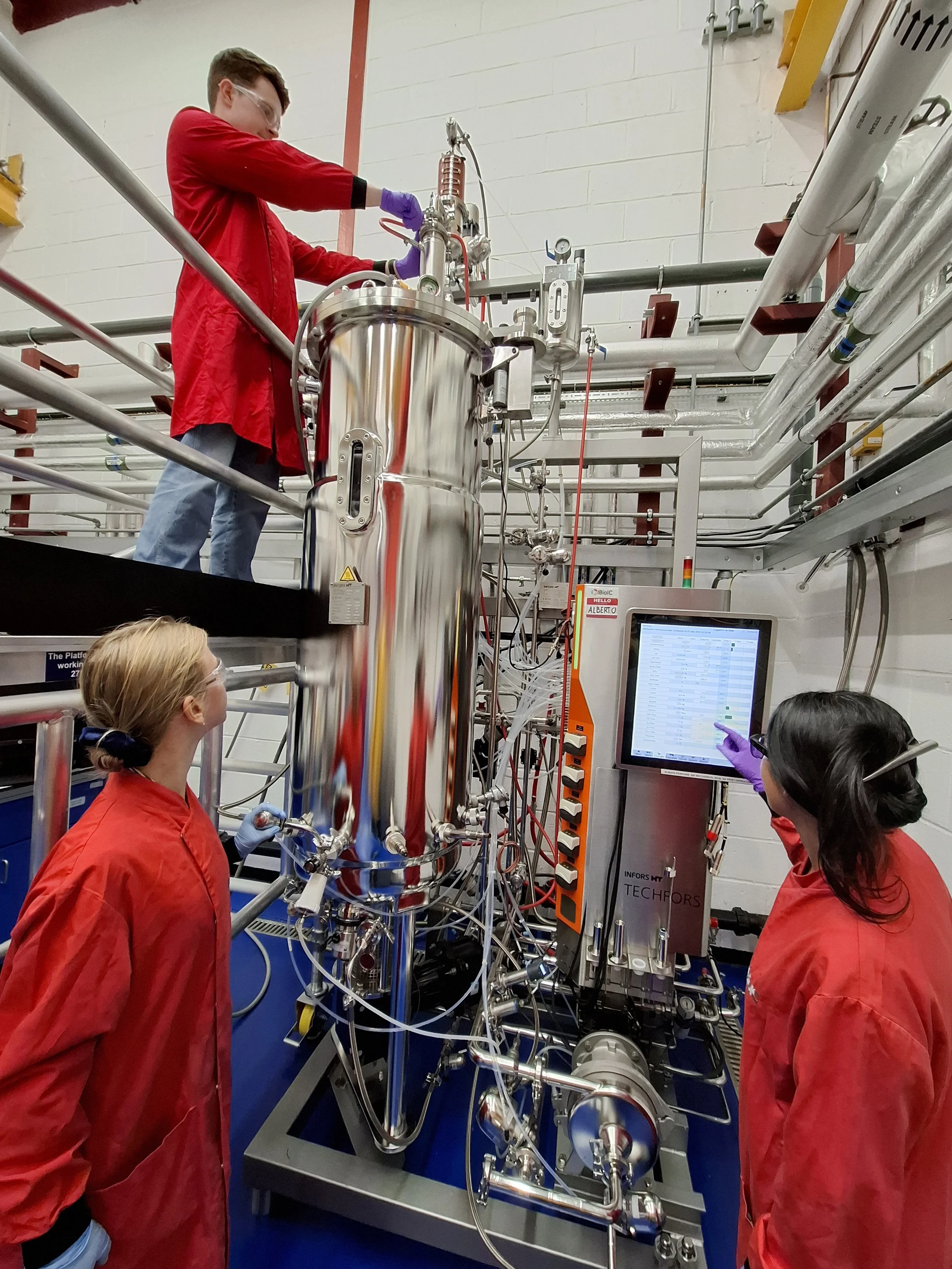
FlexBIO took HydRegen's lab-scale process and scaled it into its 300 litre TechFors fermenter, running at a 200 litre working volume (the amount of liquid actually processed in a vessel, as distinct from its full capacity).
“Access to the facilities and technical expertise has enabled us to successfully demonstrate our technology at a larger scale, giving us greater confidence as we continue towards commercialisation.”
Process established at lab scale needs to scale to 300l
HydRegen needed to supply a large volume of a enzyme intermediate to a third-party manufacturing partner. HydRegen had no route to produce this volume of material internally.
The process was well established at lab scale, but scaling it up brought several simultaneous challenges, particularly around sensitive expression conditions, as the specific growth conditions that trigger the host cells to produce the target enzyme do not always translate directly from bench to pilot scale.
Bioprocess Scale-Up facility in Scotland provides solution
FlexBIO ran a single campaign covering preparation, execution and product release, working to HydRegen's own process parameters throughout.
Technology transfer and approvals
The team began with technology transfer from HydRegen, preparing protocols and batch manufacturing records (BMRs), the documents that set out exactly how a batch is to be produced, and securing the health and safety and regulatory approvals needed to run the work.
Seed train and fermentation
FlexBIO built the seed train, the series of progressively larger cultures used to grow enough healthy cells to inoculate the main fermenter, from a cryovial (a small frozen vial used to store a cell stock) through to the 300 litre TechFors fermenter at 200 litre working volume. Conditions were carried across directly from HydRegen's bench process, with growth and sterility monitored throughout.
Harvest and release
The biomass was harvested by disc stack centrifugation, a method that separates cells from liquid using a spinning stack of discs. This was followed by dry cell mass testing, aliquoting into smaller portions and flash freezing. Process records were issued with the material, which was then packaged and shipped on for HydRegen's use.
Why FlexBIO was the right fit
The 300 litre TechFors system suited HydRegen's process because of the control strategies it offers for optimal cell growth. FlexBIO's disc stack centrifuge, already proven across a range of cell types and process fluids, was well matched to a 200 litre harvest. FlexBIO also gives clients the option to be on-site during scale-up runs, so they can see the process first-hand and feed into decisions as the run progresses.
Pilot-scale data generated and a successful product run
HydRegen received a batch of enzyme intermediate produced at 200 litre working volume, together with the full process record. This gave the company material for its demonstration with a manufacturing partner, and a documented, scalable basis for repeat production.
Beyond the material itself, the campaign confirmed that HydRegen's growth strategy scaled to 200 litre scale. This is the key question for any further scale-up of the platform, and it is now answered with pilot-scale data rather than an assumption.
Equipment used:
Infors 300 L TechFors fermenter (200 L working volume)
7 L bench fermenter (5 L working volume) for seed train development
Disc stack centrifuge for biomass harvest
GEA Panda Plus high-pressure homogeniser (breaks cells open under pressure to release their contents) for cell disruption
Offline analytics for OD600 (a measure of culture density used to track cell growth) and sterility monitoring
Core university facilities for autoclaving and waste handling